

“It’s a jam.” The man in dungarees announced. The stage erupted. A symphony of sounds coming from behind. Musicians galore, each jumping on and off stage at will. Apparently unknown to each other but somehow perfectly in time. Rhythmically entwined.
Bassists, drummers, pianists, trumpeters, saxophonists, even rappers. The dungaree man would call them up and none would disappoint. It seemed so effortless, as if years had been played between them. Not the reality of none.
At one moment, a nervous-looking trumpeter got up. He hesitated to pick his moment, his lips levitating atop the spout, questioning when to put mouth to instrument. But then he did. Announcing himself in a solo, he silenced the room in awe and built us into raptures by its end.
Next came the harmonica. Played in a way I’d never heard before, as if its own rightful member of a brass band. Dominating a stage set with louder, brasher instruments. The rapper beside him attempted to chorally match its unique beat but was interrupted. In the chaos of it all, a previous bassist has sprinted on stage and grabbed the mic.
His inner desires emitted into some sort of soulful rhythm, wailing but in musical form. The band built to its finale and he sung us out. An indescribable end to an indescribable evening. An open jam with Growve at Montreal’s Turbo Haus. The kind that leaves you energised, on a high only born from live music and performance. A high I’d missed.
On this, my farewell tour of Canada, Montreal and Toronto had surprised me. After two years in Vancouver, I hadn’t realised how much I’d longed for the energy of a big city.
The busyness, the noise, the feeling that somehow something is always going on. Even the anxiety-inducing nature of the packed pavements, the busy subways. But most of all, I’d missed the culture.
Art. Music. Theatre. Vancouver had left me constantly disappointed by the void that it is in cultural terms. That somehow a city of not insignificant size had forgotten what makes cities great. What brings them alive.
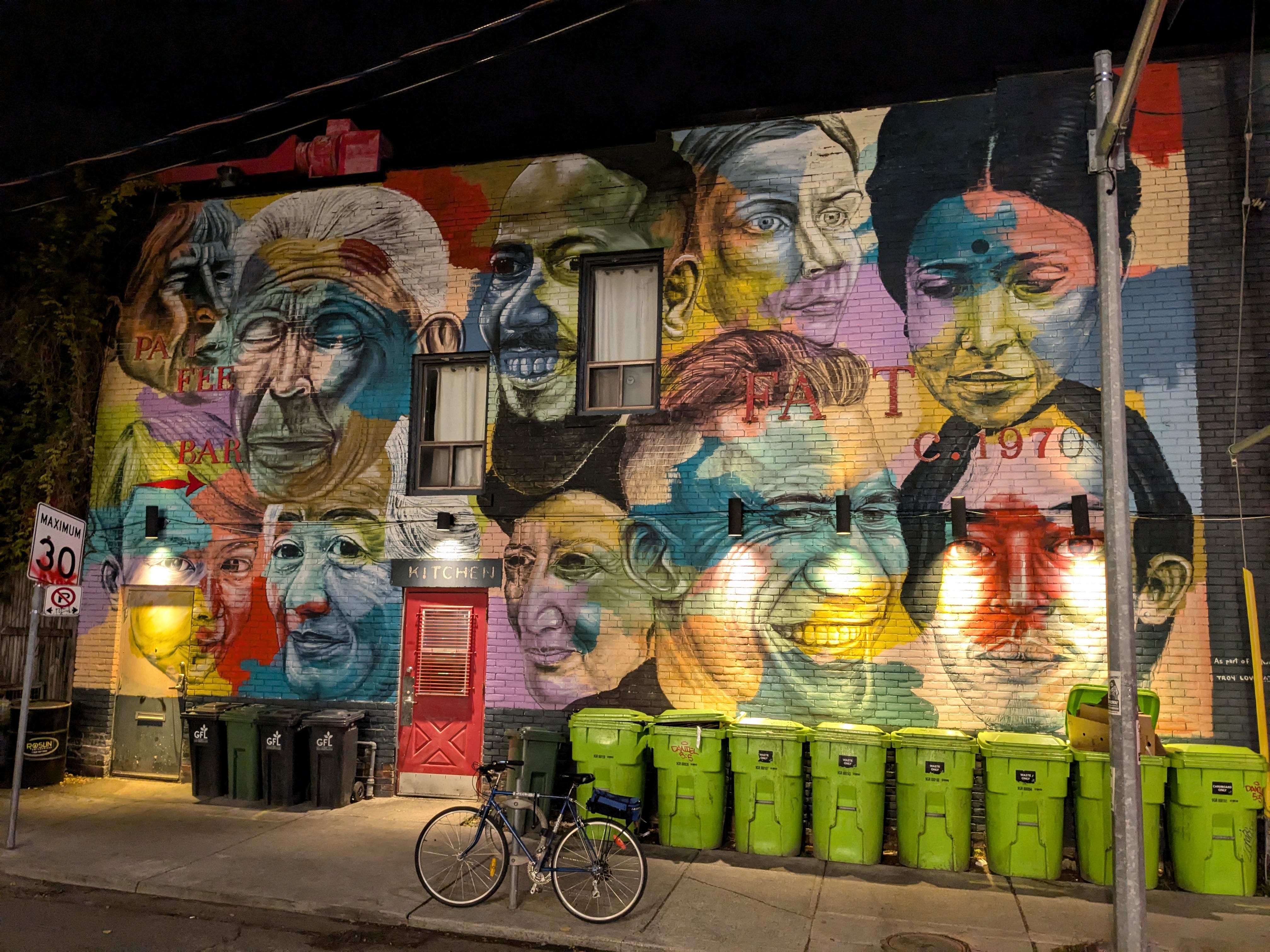
Toronto hadn’t forgotten. To my mind, it was a city with echoes of London. Architecturally it wasn’t as distant, as North American as the West Coast. The Ossington Strip felt like many a trendy high street back home, terraced, and laden in bars and cafes. Kensington Market felt as gentrified as Camden, but similarly still aesthetically appealing.
Art, like at home, wasn’t hard to find. Free too. 401 Richmond Building, an impressive four floor collection of artist studios, showcased an array of talent from the visual arts to the more traditional, many with their own political and social commentaries.
The Image Centre and The Power Plant provided further spaces to satisfy a starved mind. The latter mainly because it had bean bags. The perfect place to rest a hungover head, allow headphones to whisper words of meditation into my dreams.
A rest much needed after a night drinking with a few mums and an oversexualised Dad. Apparently pretending to be Mary, Joseph, Jesus and everything in between was exhausting work…
We had met watching an R&B cover band in The Poetry Cafe. Expecting soul and more, I was disappointed by the impressive but unoriginal performance. In stepped the pulsating Chris, a 60-year-old fellow Brit snapping his fingers and wiggling his body in an untimely manner.
Naturally, we got chatting. Our accents quickly acquiring the attention of a nearby group of women. If you’re expecting a Love Actually Colin God of Sex moment, as I always am, this is going to be disappointing.
They were the mums, all around the 40 mark, and on a rare night out. They were fascinated by my travels. Each word reliving a life they once had before children and responsibilities got in the way.
They demanded I kept going, never stopped. I laughed along, my mind quickly turning to the 50-year-old men sat alone in hostels. I wondered if they’d ever stopped. How lonely that life may be.
We whirred on, Lucy (Mum 1) talked of her own travelling tales across Asia, Chris chimed in with occasional jokes about sexualised nativity re-enactments. It was a wholesome family affair. When the music stopped, we parted our ways. Leaving behind an evening as peculiar as I could have hoped for.
I rolled on to the next venue, the next show to dip my toes into. Zinnia at the Tranzac Club. I had no idea who she or her band were. I’d read that the Tranzac Club was a not-for-profit community arts space so, I thought I’d pop in, see what it was like.
Three hours later, I emerged mesmerised. Intoxicated by what I’d heard. There is something about live music, its ability to transform. It does so like little else. It captivates and pulls you in, sets you off into wave after wave of emotional reckoning. Watching Zinnia on stage was all of that and more.
The band itself is largely the work of Rachael Cardiello, a classically trained violinist from Montana. I had apparently stumbled upon the first night of their monthly residency at the Tranzac. Titled: “This can be our living room.” It was exactly that.
A small room full of friends and fellow performers. Each one jumping up, belting out a song, and casually sitting back down as if they hadn’t just blown me away.
My personal favourite: Sam Tudor. A man adorned in a baggy top, cap, and electric guitar. His voice gentle, soothing, a calmness to it. The kind leaving me waiting on every word and disappointed at his end. But it was time for the woman herself.
Recently divorced, Cardiello was ready to bare all. A guttural emotion bounced off every wall as she sang about heartbreak, summer rebounds and the complications of being alone. There was an ethereal quality to her voice, the essence of London Grammar’s Hannah Reid within it.
Her presence on stage exemplified how the music was all her. These weren’t songs overly rehearsed or expressions of long-gone feelings, these were songs she still felt.
At one poignant moment, she dropped to her knees and bellowed out the lyrics ‘haven’t you changed?’ over and over. Screaming them into the wind of sound her band had created. A raw expression overwhelmingly powerful in such an intimate space.
Then the sound stopped. She stood, looked at the audience and softly sang the line: “Look at you now.” Let out as if the casual strum of a guitar. A sign of where she stood after it all. Happy to leave him behind?
It was a performance with a purity of emotions we could all relate to. I left caught up in my own. A smile on my face as I hopped down the street. Filled with adrenalin from what I had just seen.
The same feeling I felt days later in Montreal. Bouncing between art galleries and studio spaces. Gazing at the architectural wonder of the city’s gothic churches. Walking streets packed with activity at 11pm on a Thursday night.
It made a nice change. Both Toronto and Montreal had made a nice change. Showed me what I want from a city. What I knew I craved but didn’t know how much.
Of course, culture does exist in Vancouver. There is art, there is music. But it is limited. Organic grassroots events that I had found in two days in both Toronto and Montreal, I had struggled to find in two years in Vancouver.
This isn’t to hate on the city. I loved my life there. The people I met. The friends I made. The nature I saw, itself as overwhelming and joyful as any Montreal dungaree-filled jam.
I needed the change it gave me. The opposite of a constantly overstimulated life in London. The ability to disappear into the mountains, dip into the ocean and forget any residual stresses left behind.
But now I wanted more. I craved the stimulation. Sought the never-ending activity of a major city. The culture it hosted.
I guess it was fitting I was on my way home. London-bound.